

IIT Madras Researchers Develop VR Tool to Quantify Surgeons’ Laparoscopic Skills

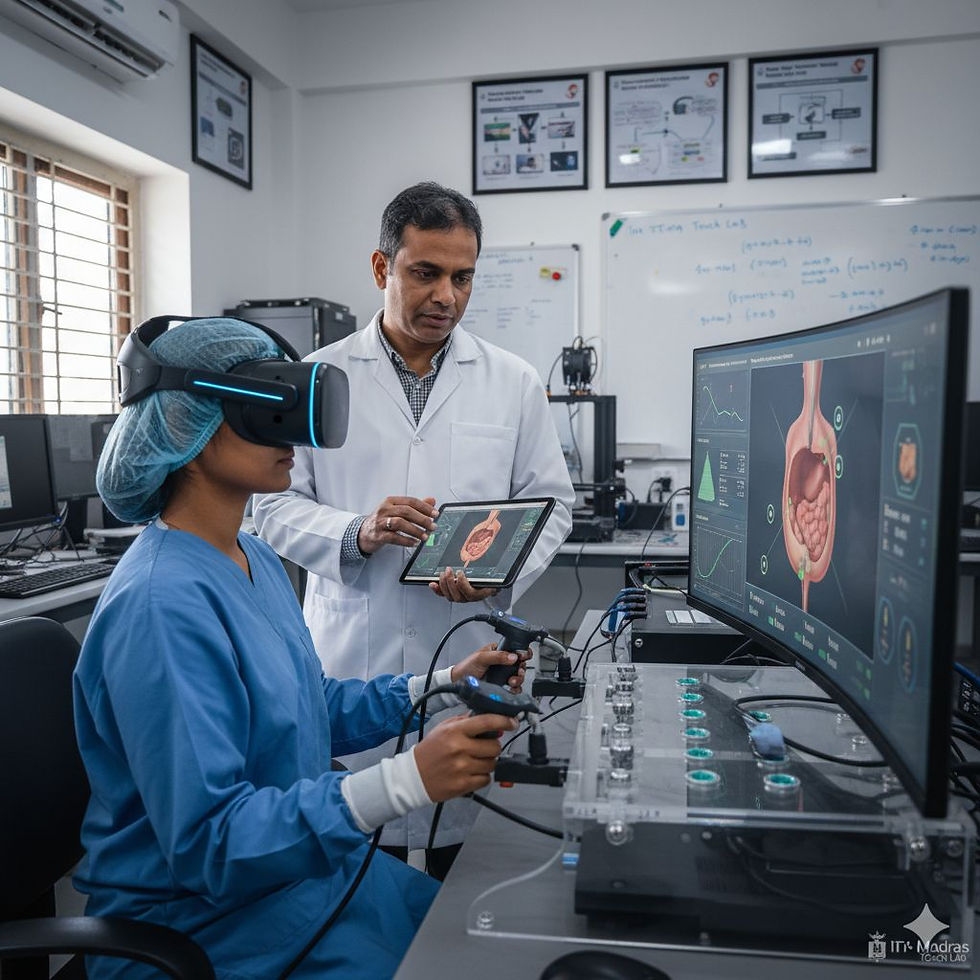
Researchers at the Indian Institute of Technology Madras (IIT-M) have developed a Virtual Reality (VR) tool designed to objectively measure the skills of surgeons performing laparoscopic (keyhole) surgeries. This innovation could help standardize how surgical skills are taught, assessed, and improved.
Laparoscopic procedures, commonly used for gallbladder removal and bariatric surgery, present unique challenges. Surgeons operate through small incisions using long instruments while viewing their actions on a monitor. This setup reduces tactile feedback, complicates depth perception, and introduces the fulcrum effect—where hand movements are inverted at the entry point, requiring surgeons to mentally remap their actions.
Prof. Manivannan M, head of IIT-M’s Touch Lab in the Department of Applied Mechanics and Biomedical Engineering, explained:
“When surgeons insert instruments through tiny cuts, they pivot at the entry point. A left-hand movement makes the tool tip move right. This inversion demands extra brain processing and slows tasks.”
Traditional training programs often rely on subjective evaluation. The new VR tool, however, uses quantitative metrics based on Fitts’ Law (a model of human motor performance) to assess precision, speed, and accuracy. By simulating surgical scenarios, the system provides measurable feedback, helping trainees improve their technique and allowing educators to benchmark performance.
This breakthrough is expected to enhance medical education, surgical training, and patient safety, offering a more reliable way to evaluate laparoscopic skills.


Comments