

India’s XR Market to Reach INR 43.6 Billion by 2030 as Enterprise Adoption Accelerates- Counterpoint report

While much of the global conversation around augmented and virtual reality has been shaped by consumer headsets, gaming demos, and metaverse hype cycles, India appears to have quietly arrived at a different conclusion: XR works best when it solves real problems at work.
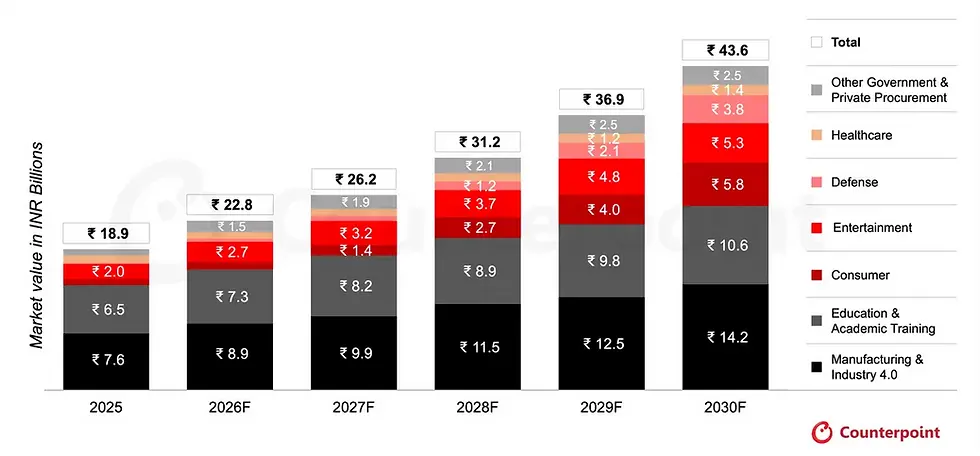
New market data projects India's extended reality sector will grow from INR 18.9 billion in 2025 to INR 43.6 billion by 2030, compounding at an 18% annual rate. That's a respectable growth trajectory by any measure. But what makes the India story genuinely instructive isn't the headline number — it's the composition behind it.
Enterprises Are Carrying the Weight
In 2025, enterprises account for a striking 95.4% of India's total XR ecosystem value. Even as consumer adoption gradually matures over the next five years, the enterprise share is expected to hold at roughly 87% by 2030. That means the overwhelming majority of headsets being deployed, software being licensed, and training simulations being built in India right now are tied to measurable business outcomes — not leisure.
This is a meaningful structural difference from markets like the United States or South Korea, where significant resources have been poured into consumer XR platforms that have struggled to find lasting product-market fit. India, by contrast, appears to have largely bypassed that expensive detour.
Manufacturing Leads, Education Follows
The two largest verticals driving this growth tell a coherent story about where XR genuinely earns its keep.
Manufacturing is the dominant sector, projected to grow from INR 7.58 billion to INR 14.19 billion over the five-year period. This isn't surprising. Factory floors and assembly lines are environments where spatial computing has a clear value proposition: reducing errors, accelerating technician training, enabling remote expert guidance, and overlaying real-time data onto physical machinery. Every minute of unplanned downtime has a cost, and XR tools that reduce that downtime have a straightforward ROI case to make.
Education follows closely, scaling from INR 6.5 billion to INR 10.56 billion. India's education system faces structural challenges — teacher shortages, geographic dispersion, and the need to train enormous numbers of skilled workers at pace. Immersive learning environments that can simulate laboratory conditions, medical procedures, or industrial equipment operation offer genuine leverage in that context. The pitch isn't novelty; it's access and scale.
Defense is also emerging as a notable vertical, with simulation-based training and mission rehearsal representing compelling use cases that governments worldwide have been quicker to fund than any consumer trend.
Hardware Is Finally Catching Up
On the device side, XR headset shipments in India are forecast to reach 151,000 units annually by 2030, growing at a 27% CAGR — faster than the overall market. That acceleration reflects both falling hardware costs and the maturation of enterprise procurement cycles, as IT departments move from pilot programs to standardized deployments.
Still, 151,000 units annually is a modest number for a country of 1.4 billion people. It underscores that India's XR story remains, for now, a B2B story — concentrated in specific verticals and organizations rather than distributed across consumer households.
A Model Worth Studying
The broader significance of India's approach may lie in what it demonstrates for other emerging markets navigating the same technology adoption question. Rather than chasing the consumer XR dream that has proven elusive even for well-capitalized Western platforms, India's ecosystem has defaulted to pragmatism: deploy where the return is clear, fund what solves a documented problem, and let the hardware follow the use case rather than lead it.
That sequencing — enterprise utility first, consumer aspiration later — may prove to be the more durable path for XR markets still finding their footing. If the projections hold, India will have a compelling five-year case study to point to by 2030. The technology press would do well to pay attention now, before the outcome becomes obvious in hindsight.
Download Full Report -https://tinyurl.com/3f58bazm


Comments