

IITM Develops AI, VR Tool to Detect Early Learning Gaps in Children

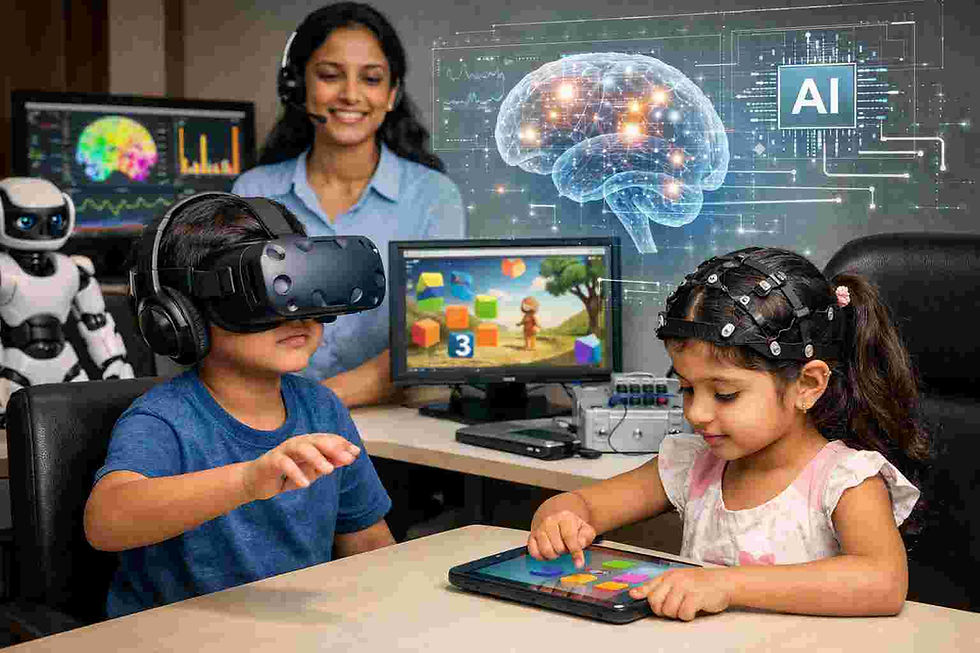
There is a quiet crisis unfolding in classrooms every day. A child stares at a math problem, guesses, erases, guesses again. A teacher marks the answer wrong and moves on. What nobody records is the hesitation, the number of attempts, the specific type of error — the behavioral fingerprint of a mind that isn't failing, but struggling in a very particular way. By the time a formal assessment flags the problem, months of foundational learning may already be lost.
Researchers at IIT Madras are working to change that timeline dramatically, and their tool of choice is a fifteen-minute virtual reality game.
Reading the Space Between Right and Wrong
The system developed at IIT Madras doesn't just check whether a child gets the answer correct. It watches how they get there. During a short VR session covering math, reading, and word tasks, the platform continuously logs response times, attempt counts, hesitation patterns, and error types — the kind of granular behavioral data that a traditional classroom test, or even an attentive teacher, simply cannot collect at scale.
A study involving 120 children aged 11 to 12 demonstrated that this approach can accurately identify students who need academic support significantly earlier than conventional assessments. We're not talking about a marginal improvement in lead time. We're talking about weeks — weeks during which targeted intervention could be building the cognitive scaffolding a child needs, rather than waiting for a grade to confirm what the struggle already signaled.
The distinction matters enormously. Most educational assessments are summative: they tell you what a student has or hasn't learned after the fact. This system is diagnostic in real time, capturing the cognitive process rather than just the outcome.
Why VR Is the Right Delivery Mechanism
It might seem like an unusual choice to route a diagnostic tool through virtual reality. But the reasoning is sound. A VR environment creates a controlled, consistent setting that removes many of the variables that muddy traditional assessments — classroom anxiety, peer pressure, inconsistent test administration. Every child encounters the same stimuli in the same way.
More importantly, the immersive format encourages children to engage naturally rather than perform. When a child thinks they're playing a game, they're less likely to second-guess themselves or mask their genuine cognitive responses. That authenticity is precisely what makes the behavioral data valuable.
The system also incorporates facial cue analysis, adding another layer of insight into engagement and cognitive load that written tests cannot approach. Combined with behavioral tracking, this positions the tool as a potential proof-of-concept for early detection of conditions including dyslexia, dyscalculia, and ADHD — three of the most commonly underdiagnosed learning differences in school-age children.
The Cost of Late Detection
The stakes of getting this right are not abstract. Dyslexia affects an estimated 10 to 15 percent of the global population, yet many children reach secondary school without ever receiving a formal diagnosis. Dyscalculia — often called the math equivalent of dyslexia — is even less understood by educators and parents. ADHD, meanwhile, frequently presents differently in quieter or more compliant children, making classroom observation an unreliable detection method.
For all three conditions, early intervention is not just helpful — it is transformative. The neural plasticity of children in their early school years means that targeted support delivered at the right moment can reshape learning trajectories in ways that become increasingly difficult later on.
The IIT Madras approach is compelling partly because of what it doesn't require. It doesn't need a specialist to administer it. It doesn't demand expensive clinical equipment. It doesn't rely on a teacher having time to notice subtle behavioral patterns across thirty students simultaneously. A fifteen-minute VR session does the heavy lifting.
From Proof of Concept to Classroom Reality
The research is still in its early stages, and scaling any diagnostic tool from a controlled study to real-world deployment involves significant challenges — infrastructure, teacher training, data privacy, and equitable access among them. Schools in under-resourced areas, arguably the environments where early detection tools are most urgently needed, are also the least likely to have VR hardware on hand.
But the underlying concept is persuasive enough that the engineering and policy questions are worth solving. If a game can tell us weeks in advance which children are falling behind — and precisely how they are falling behind — the only remaining question is whether we're willing to act on that information before the report card arrives.


Comments